
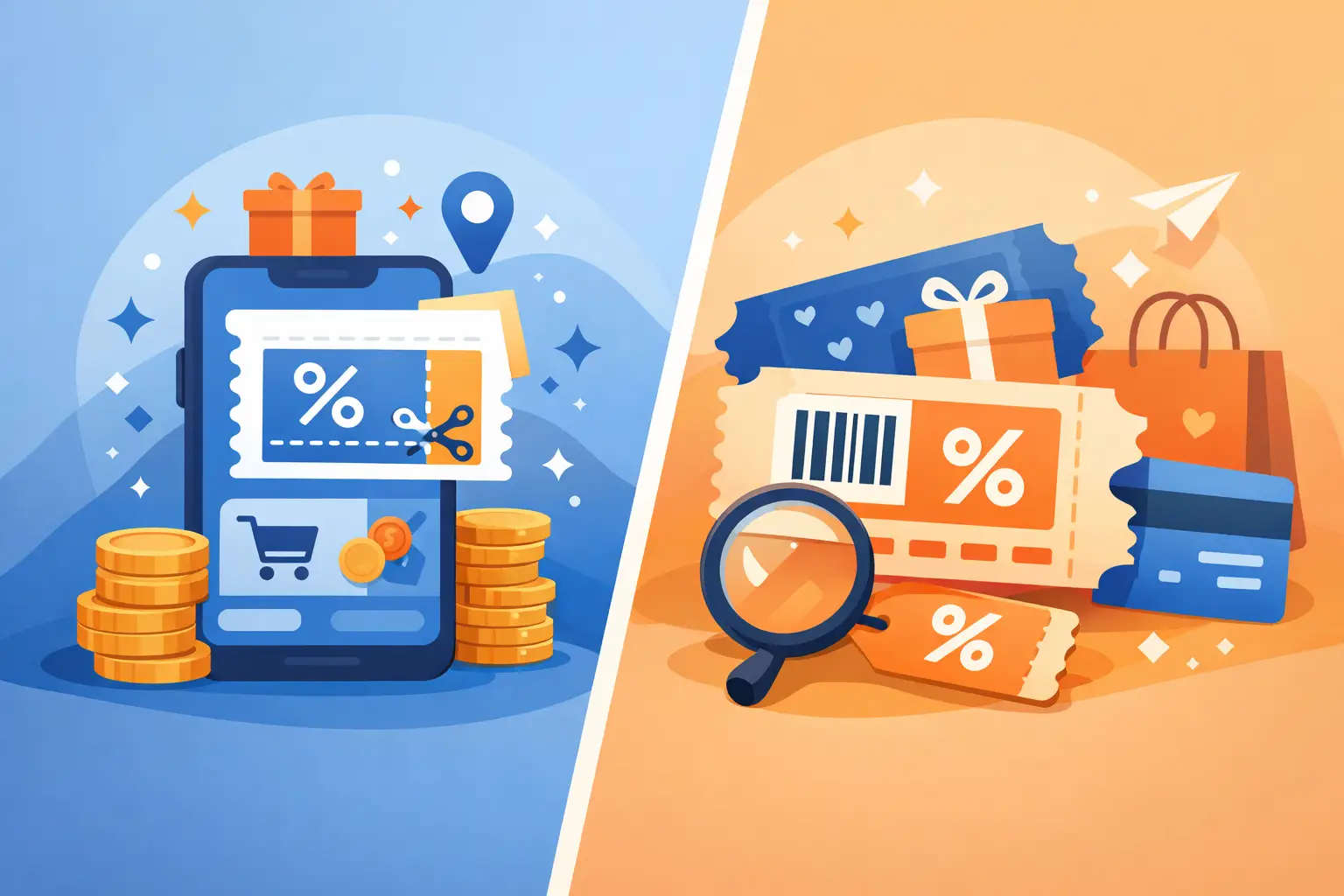
Coupon Apps vs Promo Codes: Which Saves More?
In this article
- Coupon apps vs promo codes: the real difference
- Why coupon apps often feel easier
- Where promo codes still win
- The time-cost problem most shoppers forget
- Coupon apps vs promo codes for local shopping
- When the best answer is both
- What shoppers should look for in a coupon app
- What merchants should take from coupon apps vs promo codes
- So which one saves more?
You’re in a checkout line, your cart is full, and now you’re doing the familiar last-second search for a discount. That’s where coupon apps vs promo codes becomes a real-world question, not a marketing debate. If your goal is simple - save money fast without turning checkout into a side quest - the better option depends on where you shop, what you buy, and how much effort you want to spend.
For most everyday shoppers, coupon apps usually win on convenience. Promo codes can still deliver strong savings, especially online, but they are often hit or miss. One expired code, one store restriction, or one typo and your discount disappears. A good coupon app cuts that friction down by putting active offers, local deals, and mobile-ready redemptions in one place.
Coupon apps vs promo codes: the real difference
At a basic level, promo codes are text-based discounts you enter at checkout. They’re common in ecommerce and often tied to a campaign, product launch, holiday sale, or email signup. When they work, they’re quick. When they don’t, they waste time.
Coupon apps are broader. Instead of relying on one code box, they organize offers in a mobile-friendly way so shoppers can browse by category, location, or brand. Some offers are redeemed online, some in-store, and some are tied to nearby merchants. That difference matters if you’re not just shopping for one item on one website, but trying to save across groceries, beauty, auto services, dining, and local retail.
Think of promo codes as single-use shortcuts. Think of coupon apps as a savings dashboard.
Why coupon apps often feel easier
Most people are not looking for a discount strategy. They just want a lower total and a fast checkout. That’s why coupon apps appeal to mobile-first shoppers. You open the app, check nearby offers or popular categories, tap the one you want, and redeem it from your phone.
There’s less guesswork involved. You’re usually seeing offers that are already live, already formatted for redemption, and often tied to merchants actively trying to attract customers. You do not need to copy and paste random strings from search results and hope one still works.
That is especially useful for local spending. If you need an oil change this week, a haircut this afternoon, or a dinner deal near home, a promo code search may not help much. A coupon app built around nearby offers is simply faster.
Where promo codes still win
Promo codes are not outdated. They still make sense in a few common situations.
If you already know the exact store you’re buying from and you’re shopping online, a promo code can be the quickest route to a discount. Many brands push short-term codes for first orders, seasonal sales, or cart recovery. If you catch the right one, the savings can be excellent.
Promo codes also work well for national ecommerce brands that do not rely on local discovery. If your purchase is a direct online transaction and the checkout page includes a promo field, entering a code can be a simple extra step.
The downside is reliability. Publicly shared promo codes are often expired, region-locked, product-limited, or valid only above a certain order value. So yes, the upside can be strong, but the success rate varies.
The time-cost problem most shoppers forget
A discount is only a good deal if it does not cost you more in time and frustration than it saves in dollars.
This is where coupon apps usually pull ahead. If a shopper spends ten minutes testing five promo codes to save three dollars, that experience feels bad even if one finally works. A coupon app narrows the field. It helps users discover offers that are actually meant to be redeemed now.
For busy families, commuters, and everyday shoppers, that matters. Convenience is part of the savings. No paper, no printing, no code-hunting marathon, just tap and save.
Coupon apps vs promo codes for local shopping
Local shopping is where the gap gets wider.
Promo codes are strongest in digital checkout environments. Local merchants, on the other hand, often need a simpler way to promote offers for in-store traffic, same-day services, and neighborhood discovery. A local nail salon, repair shop, restaurant, or appliance store may not have a polished ecommerce setup with a promo code engine. But they can absolutely run a mobile coupon that gets redeemed from a phone.
That makes coupon apps better suited to location-relevant savings. They are built for the way people actually shop nearby - searching by need, by category, or by what is close enough to use today.
For a shopper, the benefit is speed and relevance. For a merchant, the benefit is exposure and conversions from people already looking to buy.
When the best answer is both
This does not have to be an either-or decision.
Smart shoppers often use coupon apps for discovery and promo codes for targeted checkout savings. You might find a local electronics offer in an app, then also use a store promo code online for accessories or delivery. Or you might use a coupon app for nearby service deals while keeping promo codes in mind for larger ecommerce purchases.
The key is knowing what each tool is built to do. Coupon apps are better for browsing active savings across categories and locations. Promo codes are better for one-store, one-checkout moments where the code is valid and easy to apply.
What shoppers should look for in a coupon app
Not every app is worth your screen space. If an app makes savings feel complicated, it misses the point.
Look for a platform that is mobile-first, easy to scan, and focused on categories people actually spend on every week. Groceries, beauty, dining, auto care, travel, and household purchases are where frequent savings add up. Local relevance also matters. An app should help you find offers near you, not bury useful deals under generic listings you cannot use.
Redemption should be clear. If the app tells you exactly how to claim the offer, where it works, and whether it is online or in-store, that removes friction. A strong experience feels immediate. You open it, browse, choose, and save.
That’s the value of a platform like Mobile Coupon - putting local deals and everyday discounts in one place so shoppers can move quickly from discovery to redemption.
What merchants should take from coupon apps vs promo codes
If you run a local business, this comparison matters for you too.
Promo codes are useful if most of your sales happen through an online checkout flow. They are easy to track and can support short campaigns. But if your goal is driving store visits, filling slow appointment slots, or getting in front of nearby shoppers on mobile, coupon apps can be a stronger fit.
They give merchants visibility in a place where consumers are already looking for deals. That creates a lower-friction path from promotion to action. Instead of asking people to remember a code later, you’re meeting them when they are ready to save now.
For small and mid-sized businesses, that kind of exposure can be especially valuable. It puts the offer in front of a deal-seeking audience without requiring a complicated digital setup.
So which one saves more?
If you measure only the biggest possible percentage off on a single online order, promo codes can sometimes come out ahead. If you measure real-life usefulness across everyday spending, coupon apps often deliver more consistent value.
The better question is not which one is universally better. It’s which one gets you to a real, usable discount faster.
If you shop on your phone, buy from local businesses, and want offers you can actually use today, coupon apps usually make more sense. If you are checking out on one website and already have a valid code, promo codes are still worth using.
The smartest move is simple: keep your savings tools practical. Use promo codes when they are easy and verified. Use coupon apps when you want faster discovery, local relevance, and less friction. The best discount is the one you can find, trust, and redeem before your lunch break is over.
Deals you can use today
Real coupons from local stores. Free to claim.